
Poly(vinylidene fluoride) under finite electric displacement fields: a removable α → δ reorientation barrier and a persistent first-order δ → β conformational change
Research by Shaohui Qiu1, Jacob C. Dean1, Rajagopalan Thiruvengadathan2, Ramanujam Brahmadesam Thoopul Srinivasa Raghava3,4, and Yiming Su5,6
1Department of Chemistry and Physics, Southern Utah University, Cedar City, Utah, USA; 2Department of Engineering and Technology, Southern Utah University, Cedar City, Utah, USA; 3Department of Physics, Amrita School of Physical Sciences, Amrita Vishwa Vidyapeetham, Coimbatore, India; 4Functional Materials Laboratory, Amrita School of Engineering, Amrita Vishwa Vidyapeetham, Coimbatore, India; 5Utah Water Research Laboratory, Logan, Utah, USA; 6Department of Biological and Chemical Engineering, Utah State University, Logan, Utah, USA
Polyvinylidene fluoride (PVDF) is a polymer whose electrical properties depend on how its molecular chains are arranged. The material can take several structural forms, including three known as alpha (α), delta (δ), and beta (β). The forms have differing molecular arrangements and responses to electrical forces. Researchers can transform PVDF from one form to another by applying an electric field or mechanically stretching the material, but they have not fully understood why these methods produce different results.
Using quantum-mechanical computer simulations on computational resources at the Center for High Performance Computing, Qiu et al. investigated how electrical conditions affect the stability of these three forms and how much energy each transformation requires. Their calculations show that changing the electrical conditions can favor a progression from the α form to the δ form and eventually to the β form. The transition from α to δ requires relatively small changes in molecular structure and becomes much easier under stronger electrical conditions. In contrast, the transition to β requires substantial straightening and stretching of the polymer chains. This transformation remains energetically difficult, even under strong electrical conditions. The researchers also identified conditions under which the δ and β forms can coexist.
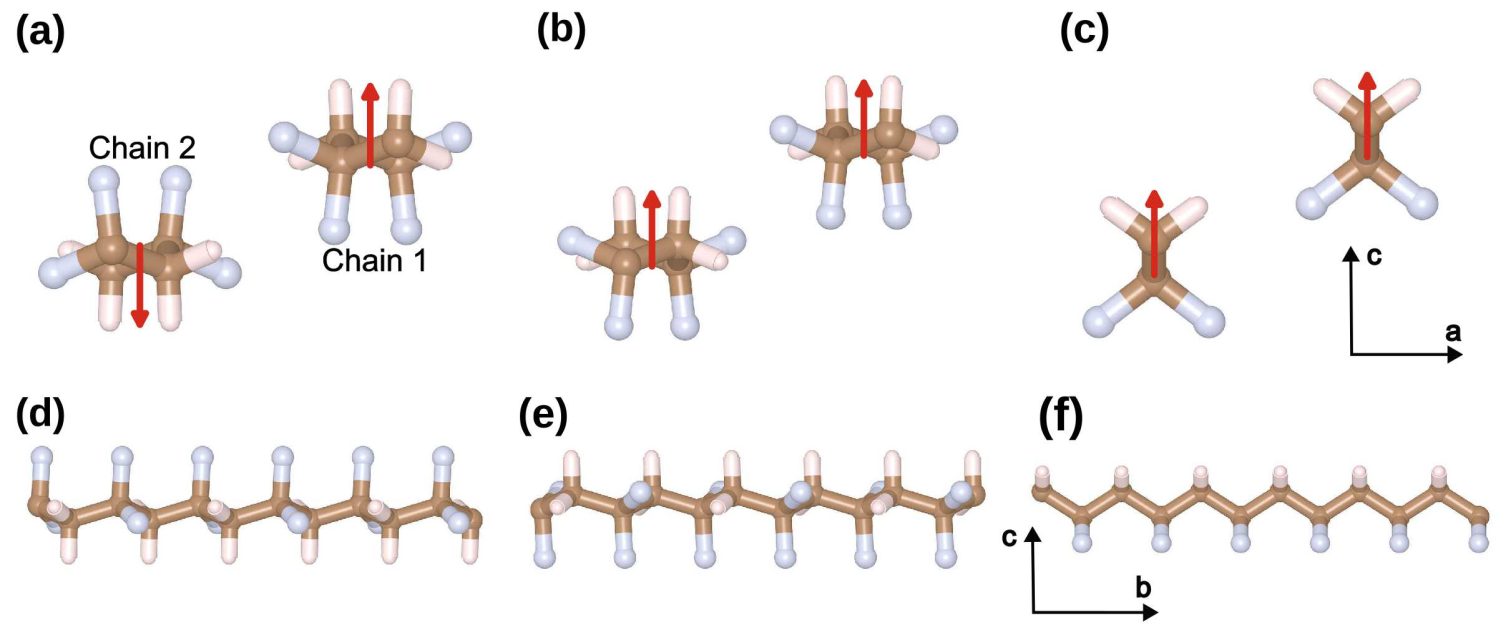
These findings help explain why applying an electric field tends to produce the δ form, while producing the β form generally requires mechanical stretching. The results also suggest that modifying how the polymer's molecular structure responds to electrical forces could make it possible to produce the β form using an electric field alone. Although the team primarily modeled idealized conditions at absolute zero, their preliminary estimates indicate that temperature may affect the relative stability of the different structures. The study provides a foundation for developing new ways to control the molecular structure and electrical properties of PVDF.
The researchers shared a preprint of their manuscript if you would like to learn more.